

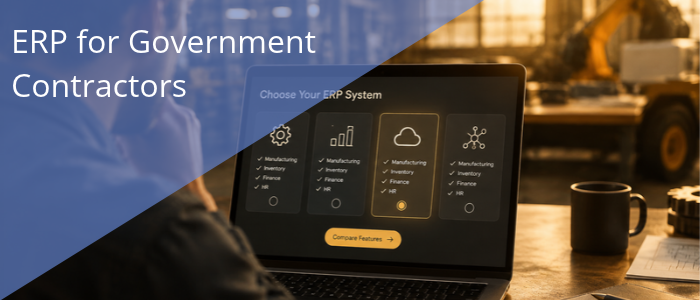
If you work at a government contractor, you already know a standard ERP wasn’t built for your world. Cost-plus, fixed-price, time-and-materials (T&M), and hybrid contracts all demand different cost tracking. On top of that, you have Federal Acquisition Regulation (FAR) and Defense Federal Acquisition Regulation Supplement (DFARS) requirements, audit-ready financial records, and labor and indirect costs that have to be tracked accurately.
Jonathan Kucharski

Recent Posts
ERP for Government Contractors: Why CloudSuite Industrial Stands Out
Topics:
ERP selection
CloudSuite Industrial
Continue Reading
How AP Automation Works Inside Infor CloudSuite Industrial
If you're running AP for a manufacturer, you've probably felt this squeeze already. Invoice volumes keep climbing, but AP headcount rarely keeps pace. Manual data entry eats up valuable time, approval delays can mean missed discounts or late payments, and limited visibility makes it harder to manage your liabilities and cash flow.
Topics:
CloudSuite Industrial
Infor Visual
Continue Reading
How Robotic Process Automation Works Inside Infor ERP

Many manufacturers invest in a powerful ERP like Infor CloudSuite Industrial (CSI/SyteLine) to improve operations, increase visibility, and support growth. Yet even with a modern ERP, many day-to-day business processes still depend on employees manually entering data, moving information between systems, or completing repetitive administrative tasks.
Topics:
Infor Visual
Continue Reading
Process Mining in Infor CloudSuite Industrial: Uncover Hidden Inefficiencies
Most manufacturers already have defined processes inside their ERP system. The problem is that day-to-day operations don’t always follow them. In systems like Infor CloudSuite Industrial (CSI), workflows are carefully designed, but what’s documented isn’t always what happens in practice.
Topics:
CloudSuite Industrial
CSI Features
Continue Reading
Infor Velocity Suite: What it Means for Manufacturers
Manufacturers today face constant pressure to innovate while navigating supply chain disruption, labor constraints, and growing operational complexity. Many organizations see the value of automation and AI, but traditional transformation initiatives can take years before delivering meaningful results.
Topics:
CloudSuite Industrial
Infor Visual
Continue Reading
Are You Sure You Need an ERP Migration?
ERP migration has become almost automatic.
Topics:
ERP deployment
Manufacturing Data
Continue Reading
ERP System Architecture Explained in Layman’s Terms
When manufacturers start exploring ERP systems, they often hear the term “ERP architecture.” It can sound technical and abstract, but the reality is much simpler. ERP architecture is really about how an ERP system is structured and how well it supports the way your business operates.
Topics:
ERP implementation
Continue Reading